
The form in which companies record the working hours of their employees is not statistically known. In our experience, however, the use of electronic time recording systems has increased in recent years. This is also consistent with the ruling of the Federal Labour Courtcourt (BAG) of 13. Since then, companies in Germany, among other countries, have been obliged to systematically record and document working hours. The BAG’s decision is intended to ensure that working hours are recorded correctly, overtime is compensated and breaks are properly observed.
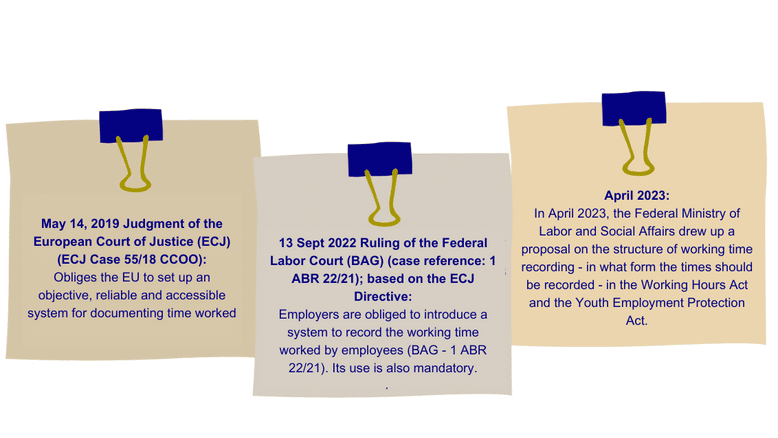
From a proposal by the Federal Ministry of Labour and Social Affairs since April’ 23 it is now also clear that efforts are being made to reach an agreement on the structure of working time recording. All in all, the entire topic is based on a ruling by the ECJ from May 2019.
For the sake of clarity, here is a brief chronicle of the relevant announcements:
Facts about mandatory working time recording
The complexity of the topic of time recording raises various questions. Below we have summarized some key information on the mandatory documentation of working hours.
- Do all companies really have to record employees' working hours?
- What do the legal requirements for recording working hours mean for you as an employer?
- How do you prepare your company for the introduction of time recording software?
- What advantages does electronic time recording offer companies?
- What must time recording software be able to do?
- Frequently asked questions about the law on working time recording
Do all companies really have to record employees' working hours?
Regardless of their size, all companies in Germany are obliged to record the working hours of their employees. This applies equally to small, medium-sized and large companies and to all employees. Currently, the only exception is senior executives, although it should be noted that not every manager is automatically classified as a senior executive. The exact requirements for the type of working time recording itself can also vary depending on the size of the company and the industry. If you are unsure, it is always advisable to seek legal advice or support from experts in the field of employment law.
What do the legal requirements for recording working hours mean for you as an employer?
While companies are already obliged to record time, the form in which working time must be recorded has not yet been specified. Whether handwritten, in Excel or via time recording software – companies must document the start, end and duration of working hours.
Of course, the electronic recording of working times using appropriate time management software is particularly convenient and less prone to errors.
Expert tip:
There are a number of software solutions for electronic time recording on the market. In our opinion, you should take sufficient time to select the right HR software and also seek detailed advice.
How do you prepare your company for the introduction of time recording software?
The successful introduction of time recording software requires a well-thought-out strategy. In addition to selecting the right time management software, it is just as important to communicate in good time.
If you have been recording your employees’ working times manually anyway, you are “only” facing the introduction of a new, digital form of implementation. If, on the other hand, you have previously only recorded overtime worked as part of trust-based working hours, the communication process may be somewhat more complex. Transparency and communication must be emphasized in any case. Make it clear to your employees that electronic time recording is less a means of control than a decision to protect employees. Maximum daily working hours or corresponding rest periods can sometimes be lost sight of in the rush.
Expert tip:
Start by developing clear guidelines and processes for the introduction and use of time recording software in your company. Designate contact persons, provide comprehensive information, take potential concerns seriously and train your employees in good time on how to use the technology you will be using in the future.
What advantages does electronic time recording offer companies?
- Increased efficiency: Automatic recording of working hours saves time and effort for both employees and the HR department. Employees do not have to keep handwritten records, and overtime and vacation days are calculated automatically.
- Avoidance of overtime: By accurately recording working hours, companies can better control and avoid overtime. This helps to optimize labour costs and ensure compliance with working time regulations.
- Transparency and compliance: Digital time recording systems contribute to compliance with working time regulations and legal provisions. This reduces the risk of violations and legal problems.
- Reporting and analysis: Companies can create comprehensive reports and analyses using digital time recording. This data makes it possible to identify working time trends, plan resources better and make decisions to improve efficiency.
- Integration with other systems: Modern time and attendance systems often integrate seamlessly with other business systems such as payroll, accounting and HR software, simplifying administration and data exchange.
What must time recording software be able to do?
Automated calculations
User-friendly interface
Flexibility
Integration
Reporting
Customer support and training
Frequently asked questions about working time recording
When did working time recording become mandatory?
Time recording has been mandatory since September 2022. Recording in electronic form is a time-saving alternative to time-consuming manual documentation.
What is likely to change for employees in terms of time recording?
It is possible that there will be a specification on the way in which working hours are to be recorded – electronically, for example.
Who is obliged to record working hours?
In Germany and the EU, all companies are obliged to record the working hours of their employees.
Is electronic time recording mandatory?
Recording working time in electronic form is not mandatory. Possible resolutions on a mandatory form of recording by BAMS remain to be seen.
Which working time recording software is right for my company?
Good news! You’ve come to the right place. Book HERE for a free expert consultation or receive a free software recommendation directly via our analysis tool.